
Your group wants to lift one business line out of its Polish company - a product division, a real-estate arm, a services unit - into a separate entity, while the original company carries on trading. You might be ring-fencing risk, dressing that line up for sale, or building a tidier sub-holding under the parent. In Poland two routes do exactly this, and since a 2023 reform the more useful of the two finally exists. Picking the right one, and understanding what it quietly does to your ownership chart, is the difference between a clean reorganisation and an expensive surprise.
Which routes keep the old company alive?
A Polish demerger (podział) comes in several forms. Most of them make the company being divided (spółka dzielona) disappear: its whole estate is parcelled out and it is struck off the register. Two forms do the opposite - they move only part of the assets and leave the company being divided standing. These are the partial demergers, and they are the only ones relevant when the point is to keep the original company trading:
- demerger by spin-off (podział przez wydzielenie) - Art. 529 § 1 item 4 of the Commercial Companies Code (Kodeks spółek handlowych, “KSH”);
- demerger by separation (podział przez wyodrębnienie) - Art. 529 § 1 item 5 KSH, added with effect from 15 September 2023.
In both, the company being divided is not dissolved. The carve-out takes legal effect either on registration of the new company, or - where the assets go to a company that already exists - on registration of that company’s share-capital increase (Art. 530 § 2 KSH). The full demergers, where the company is dissolved and its whole estate passes to others, are a separate topic.
The one difference that decides everything: who gets the shares?
Both routes move a defined slice of the business into a recipient company in exchange for shares. They differ on a single point - who takes up those shares - and that single point reshapes your group:
| Feature | Demerger by spin-off (wydzielenie) | Demerger by separation (wyodrębnienie) |
|---|---|---|
| Shares in the recipient go to… | the shareholders of the company being divided | the company being divided itself |
| Company being divided survives? | yes | yes |
| Resulting structure | recipient is a sister company | recipient is a subsidiary |
| Legal basis | Art. 529 § 1 item 4 KSH | Art. 529 § 1 item 5 KSH |
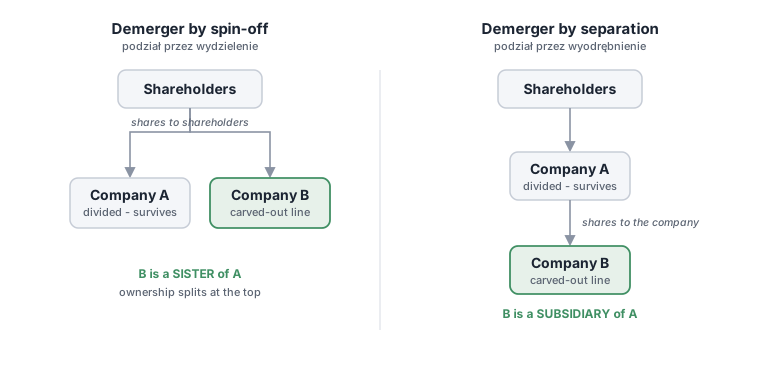
After the demerger, a spin-off leaves the new company a sister of the original; a separation leaves it a subsidiary.
The statute makes the point almost in passing: under Art. 531 § 5 KSH the shareholders of the company being divided become shareholders of the recipient on a spin-off, as on a full demerger - separation is deliberately left out, because there the shares belong to the company, not its owners. In plain terms: spin-off pushes the new company sideways to your shareholders; separation keeps it underneath, in the group.
Why separation changed intra-group carve-outs
For an international group reorganising its Polish operations, separation is usually the one you want, and the reason is practical rather than theoretical.
In plain terms: before separation existed, when I needed to hive off a business line I did it by contributing an organised part of an enterprise (aport ZCP) into a new company. Since demerger by separation arrived, I can finally run the carve-out as a demerger - and the legal difference is enormous. The demerger gives me universal succession tied to the transferred business; the contribution did not. With a contribution I had to obtain each counterparty’s consent to move the contracts across, which, for a live, operating business, was slow and awkward. A demerger is heavier on paper, but for my clients that formalism is a price worth paying, because succession carries everything over by itself.
Here is why that matters. On the effective day the recipient steps into the rights and obligations allocated to it in the demerger plan by operation of law (Art. 531 § 1 KSH). Administrative permits, concessions and reliefs tied to the moved assets pass with them - unless a statute, or the specific decision granting the permit, provides otherwise (Art. 531 § 2 KSH), which is exactly why each regulated permit is checked rather than assumed to travel. The recipient even takes over pending litigation about the moved assets without the other side’s consent (Art. 531 § 2¹ KSH). That is universal succession, and an ordinary asset transfer does not give it: there, each contract, each permit, each counterparty has to be dealt with one by one.
What you skip with a separation
Because no shares go to the shareholders, the machinery that exists to protect them from an unfair share-exchange ratio simply switches off. For a separation the law disapplies the exchange-ratio and share-allocation content of the plan, the management board’s report justifying the demerger and the examination of the plan by a court-appointed expert (Art. 529 § 2 KSH, disapplying parts of Art. 534, and Art. 536 § 1, 537, 538 and 541 § 5 KSH). There is no ratio to argue about, because the owners’ proportions do not change.
There is a second, quieter saving. The rules on forming the recipient apply except the rules on contributions in kind (Art. 532 § 1 KSH). For precision: this is what sets a separation apart from an ordinary in-kind contribution of the same business - you get the new subsidiary holding the business line, but without the in-kind-contribution valuation regime that a contribution would drag in. The exception is a joint-stock company (S.A.) as the recipient: there a statutory-auditor valuation of the assets applies after all (Art. 538¹ § 3 KSH).
A practitioner’s tip: put the recipient in place first
A separation can transfer the business into a brand-new company that only comes into existence on the demerger day, or into a company set up beforehand and owned by the company being divided itself, so that after the separation the recipient is wholly its subsidiary. I use the second route, and the reason is operational. If the recipient already exists on the demerger day, it trades from that day - it has its tax number (NIP), it is registered for VAT, and its bank accounts are open. Take the other route, where the recipient is created on the demerger day itself, and it arrives not yet ready to trade - the tax number, VAT registration and bank accounts still have to be put in place before it can function normally, and opening the bank accounts alone takes at least two weeks - one to two months where the group structure is long or unusual. For a live business, that is precisely the gap you do not want.
What this means for you
If the goal is to move a business line within the group - into a fresh subsidiary you will keep, sell later, or use to isolate risk - demerger by separation is now the natural tool - in my practice it has replaced the asset-contribution route for that job. If instead the goal is to split ownership at the top - to hand a business to some of the shareholders and not others - the spin-off is the route, because it delivers the shares to the shareholders directly. Everything else being equal, the deciding question is not “which is simpler to run” but “where do I want the new company to sit on the chart”.
Watch out
- Three-year joint liability. For liabilities the plan allocates to a recipient, the company being divided and any other recipient are jointly and severally liable with it for three years from the announcement of the demerger - the recipient in full, the others capped at net assets (Art. 546 § 1 KSH). A clean carve-out on paper does not fully sever the old company for three years.
- Universal succession is not immunity from change-of-control clauses. Succession moves a contract without the counterparty’s consent - but a change-of-control or anti-assignment clause inside that contract can still hand the counterparty a termination right.
- ZCP sits at the centre - even though it is a tax concept. Corporate law asks only that you move a part of the assets (Art. 529 KSH), and does not require that part to be an organised part of an enterprise. Tax law does: for the demerger to be tax-neutral, the part you move and the part that stays must each be an organised part of an enterprise (zorganizowana część przedsiębiorstwa, “ZCP”). In practice ZCP is therefore on the table in almost every one of these projects from the outset - you design the carve-out around it, together with your Polish tax adviser, rather than treating it as an afterthought.
- It is not instant. In practice the process runs to about four to six months; the step-by-step timeline, and what adds time, is in How long does a Polish demerger really take?
- Some permits do not travel. The pass-through of permits and concessions has carve-outs - notably where a statute or the decision itself provides otherwise, and for a financial institution’s licences, where the authority can object within one month of the plan’s publication (Art. 531 § 2 and § 6 KSH). Map the group’s licences early.
Next steps
- Decide the destination first: subsidiary (separation) or sister (spin-off).
- Where possible, set up the recipient company in advance, owned by the company being divided, so it is fully operational - tax number (NIP), VAT registration, bank accounts - on the demerger day. (I usually deliver these companies to clients as part of the project.)
- Talk to your tax adviser early - it is worth checking, and often actively shaping, the carve-out so that both the moved part and the part that stays qualify as a ZCP.
- Inventory the contracts, permits and litigation tied to the business line, and flag any change-of-control clauses.
- Have the demerger plan drafted, including the description and allocation of assets and liabilities (Art. 533–534 KSH; for a separation, the plan states the shares the company being divided takes up - Art. 534 § 1 item 2¹ KSH).
- Budget roughly four to six months to registration.