
Your Polish subsidiary had a good year, and the group wants the cash upstream. At home that might be a board decision taken over a call. In Poland, two formal gates sit between the profit in the accounts and the money in the parent’s account: a corporate gate - who decides, on what and when - and a tax gate - what is withheld on the way out. Neither is hard. Both are procedural, and both reward planning the timing in advance rather than discovering the rules on the payment date.
Who decides a dividend - and when can it even be decided?
A dividend is a shareholders’ decision, not a management-board one. The shareholders have a right to the profit shown in the annual financial statements and allocated to distribution by their resolution. That resolution belongs to the ordinary shareholders’ meeting, which must be held within six months of the end of the financial year (Art. 231 § 1 KSH), and which does two things in the same sitting: it approves the financial statements and it resolves on the distribution of profit.
The sequence matters - there is no dividend before the accounts for the year are approved - and so does the frequency. In plain terms: the profit is distributed once a year, at that annual meeting. In my experience, clients used to other systems are often surprised by this - they cannot simply declare a distribution of profit whenever the group wants cash, and here I do not mean an interim dividend, but the distribution of the profit itself. Between annual meetings, cash can still reach the shareholder by other routes - an interim dividend, a redemption of shares, a repayment of additional contributions (dopłaty) where the company has them, or a reduction of the share capital - but none of these is a fresh distribution of profit.
How much can you actually distribute?
Polish law caps the distributable amount. Under Art. 192 KSH, the sum available for distribution may not exceed the profit for the last financial year, increased by undistributed profits from earlier years and by reserves created out of profit that are free to be distributed, and reduced by any uncovered losses, own shares, and amounts that the law or the articles require to be set aside to reserves.
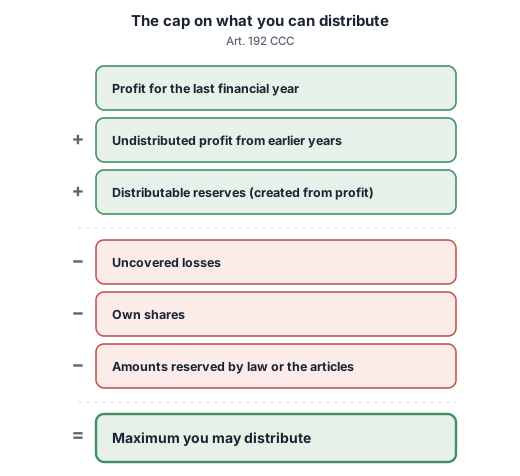
In plain terms: it is not simply “last year’s profit”. At the annual meeting, a company sitting on retained earnings from earlier years can distribute those too - the so-called super-dividend - provided they sit in distributable reserves and the formula still balances after the deductions.
For precision: what counts as a distributable reserve is not always obvious. Amounts held in supplementary capital (kapitał zapasowy) or reserve capital (kapitał rezerwowy) can usually be reached for a dividend, but only where they were created out of profit and are not tied up by law or the articles. Run the number with the company’s accountant before naming a figure upstream - this is the line most often crossed by accident.
When does the money actually reach the shareholder?
Entitlement is fixed on a single date: the dividend day (dzień dywidendy). By default that is the day the profit-distribution resolution is passed; the meeting can instead set a separate dividend day, but it must fall within two months of the resolution. The dividend is then paid on the day the resolution names, or immediately after the dividend day if it names none.
For a wholly-owned subsidiary this is a formality, because the parent holds the shares throughout. It matters the moment ownership is about to change - in an intra-group transfer or a sale - because the dividend day decides which owner collects.
Can you pay before the year-end? Interim dividends
Yes, but on conditions. The management board may pay an interim dividend (zaliczka na poczet dywidendy) only if the articles of association authorise it. If they do not, the fix is straightforward, if not instant: amend the articles to add the authorisation and register the change in the KRS - in practice around two to four weeks. Even with the authorisation in place, the last approved annual financial statements must show a profit, and the advance is capped at roughly half the profit earned since the previous year-end, plus distributable reserves, less losses and own shares.
The trap is repayment. If the company then closes the year at a loss, or at a profit smaller than the advances paid, the shareholders must give the money back - in full where there is a loss, or in the excess part where the profit falls short (Art. 195 § 1¹ KSH). An interim dividend is a loan against a result that has not happened yet, and the group should treat it as one.
For precision: unlike a joint-stock company (S.A.), a sp. z o.o. does not need its accounts examined by an auditor before it pays an interim dividend - the statute asks for an approved prior-year statement showing a profit, not an audited one.
What gets taken off the top? Withholding tax
A dividend paid by a Polish company is subject to a flat 19% withholding tax (Art. 22(1) of the Corporate Income Tax Act). For a foreign parent, that headline rate is often not the rate actually paid. The EU/EEA participation exemption can bring it to zero where the recipient is a company taxed on its worldwide income in Poland, the EU or the EEA, holds at least 10% of the shares directly, and holds them for an uninterrupted two years - a period that may complete after the payment (Art. 22(4) CIT Act). Where the exemption does not apply, a double tax treaty will usually reduce the rate.
None of this is automatic. Since 2019 the paying company, as withholding agent, must exercise real due diligence on the recipient’s status, and on payments above PLN 2 million a year to a related non-resident the tax is withheld at 19% and reclaimed afterwards - the “pay and refund” mechanism - unless the company files the statutory management-board statement that switches it off. The exemption and any treaty relief also depend on the recipient being the beneficial owner of the dividend.
I am an advocate, not a tax adviser: this article signposts the tax; it does not plan it. The rate, the exemption, the documentation and the beneficial-owner analysis are for your Polish tax adviser to confirm before the payment date - the withholding-tax rules change often, and the cost of getting them wrong lands on the Polish company as the payer.
What this means for you
Plan the cash timeline around the annual meeting, not around when the group wants the money: the approved accounts are the gate, and there is only one such meeting a year. Before you promise a mid-year payment upstream, check whether the articles authorise an interim dividend - many standard Polish articles do not - and keep the alternative routes in mind - an interim dividend, a redemption of shares, a repayment of additional contributions, or a reduction of the share capital. And settle the withholding-tax position and its paperwork before the dividend day, because the payer carries the risk and, above PLN 2 million, the cash-flow hit.
Watch out
- Paying more than the formula allows, or before the accounts are approved, is an unlawful distribution: the recipient must return it, and the board members responsible are jointly liable for the repayment (Art. 198 KSH).
- The interim-dividend repayment duty bites if the year underperforms - do not treat an advance as final cash.
- The pay-and-refund threshold turns a large dividend into a financing question: above PLN 2 million a year to a related non-resident, 19% is withheld and reclaimed later unless the management-board statement is filed in time.
Next steps
- Confirm the financial year is closed and the financial statements approved by the shareholders.
- Read the articles of association: the default profit split, any dividend preference, and whether the board may pay an interim dividend.
- Run the Art. 192 number with the accountant before naming a figure.
- Pass the profit-distribution resolution; set the dividend day and the payment day.
- Fix the withholding-tax position and documentation before the payment date.