
Somewhere in a group’s Polish structure there is usually a specific problem: cash sitting in a subsidiary that has to be out before a sale, a shareholder who should no longer be on the register, or a holding tier that was useful once and is now in the way. A dividend does not solve any of these, because a dividend pays everyone in proportion and changes nobody’s shareholding. This is where redemption earns its place: it pays out the company’s own money and, in the same step, takes shares out of existence.
It is also one of the more misunderstood instruments in Polish company law - partly because the same word covers three quite different operations, and partly because the Code lets you pay for it in two ways that look similar and behave very differently. This article takes the two decisions apart: which type of redemption you are doing, and where the money comes from.
What a redemption actually does
A redemption extinguishes a share. The share stops existing, and with it every right and obligation attached to it. The shareholder whose share is redeemed is normally paid for it - the Code calls this a “remuneration” (wynagrodzenie) - unless they agree to give the share up for nothing.
In plain terms: a dividend takes money out of the company and leaves the cap table untouched; a redemption reaches into the cap table itself and removes part of it. That is why it answers questions a dividend cannot - how to pay a shareholder out between annual meetings, how to let one shareholder exit without a buyer, how to take a holding tier out of the structure.
Two limits apply to every redemption, whatever its type. It can only be done after the company is registered - a company in organisation cannot redeem - and it extinguishes a whole share: you cannot “partly” redeem a share by cutting its nominal value. Where a shareholder holds several shares, you redeem some of them.
First, the articles have to allow it
Redemption is not a default power. It is available only if the articles of association (umowa spółki) say the company’s shares may be redeemed (Art. 199 § 1 KSH). A plain enabling clause is enough for the voluntary route. For the compulsory and automatic routes the articles must go further and set out the grounds and the procedure - without them, those routes simply do not exist for that company.
If the clause is missing, you amend the articles first: a shareholders’ resolution recorded by a notary, a two-thirds majority, and registration in the National Court Register (KRS), which is what makes the change effective (Art. 255 § 1, Art. 246 § 1 KSH). For a wholly-owned subsidiary that is a controlled formality, but it is a step with its own timetable - worth knowing before you promise head office a redemption “next week”.
The three types of redemption
| Feature | Voluntary (dobrowolne) | Compulsory (przymusowe) | Automatic (automatyczne) |
|---|---|---|---|
| Consent of the affected shareholder | Yes - the company buys the share from them | No | No |
| How it is triggered | Shareholders’ resolution + acquisition of the share by the company | Shareholders’ resolution on the grounds set in the articles | A defined event occurs - no shareholders’ resolution; a board resolution where capital must be reduced |
| Must be pre-wired in the articles | An enabling clause | Grounds and procedure | Grounds and procedure |
| Remuneration | Freely agreed (or none, with consent) | Set in the articles, not below the statutory floor | Set in the articles, not below the statutory floor |
| Typical use | The workhorse - paying out, exits, tidying structure | A safety mechanism, rarely fired | A disciplining mechanism in joint ventures |
Voluntary redemption is the one you will use most. The company acquires the share from the shareholder - with their agreement, which is the “voluntary” part - and then cancels it. The acquisition is a transfer of a share, so it takes written form with notarised signatures (Art. 180 KSH). Commercially it is flexible: the price is whatever the parties agree, within the funding limits below, and with the shareholder’s consent the share can be given up for nothing at all.
Compulsory redemption happens without the shareholder’s consent - but only on the grounds and by the procedure the articles already contain, and the remuneration cannot be set below a statutory floor: the net-asset value attributable to the share shown in the last financial statements, less the amount earmarked for distribution (Art. 199 § 2 KSH). The resolution also has to give reasons.
It is tempting to think of compulsory redemption as a tool for forcing a shareholder out. In practice it is not really that. Because the grounds and procedure must be in the articles, and a shareholder joining the company accepts them when they sign up, compulsory redemption works as a safety mechanism built into the deal in advance, not as a weapon you reach for in a live dispute. You cannot bolt it on to deal with a shareholder you already have a problem with - see Watch out.
Automatic redemption is the same idea with the trigger automated: the articles name an event, and when it occurs the shares are redeemed without a shareholders’ resolution. The Code requires a management board resolution only where the share capital has to be reduced: the board then resolves the reduction without delay, unless the redemption is paid out of net profit (Art. 199 § 4–§ 5 KSH). In practice - and under well-drafted articles - the board also records in a resolution that the event has occurred, so there is a document behind the updated share register and the KRS filing. The Code does not prescribe what the event has to be; that is for the parties to design - a partner who fails to fund the company, one who takes up a competing business, a change of control on a partner’s side, the loss of a licence the venture depends on, a partner’s insolvency. Which of those belong in a given set of articles is a drafting choice; once they are in, the mechanism runs itself. It is treated as a form of compulsory redemption, so the same floor and the same “it must be in the articles” rule apply, and its natural home is a joint venture, where it is the cleanest disciplining device there is.
In a joint venture the articles can tie redemption to a partner’s own conduct, so that a defined failure on their side takes them out of the company without anyone having to go to court for it. For a defaulting partner there is no simpler or more effective sanction: no resolution to block, no vote to lose, no court to persuade - the event occurs and the shares are gone. In one venture, for example, I built the trigger around funding: a shareholder who twice refused to put in the money they had committed triggered the automatic redemption of all of their shares.
That mechanism is the sharp end of a theme that also runs through funding: a shareholder who will not pay what they signed up to pay can be dealt with through redemption - the same Art. 199 that sits behind the sanction for unpaid additional contributions (dopłaty).
Where the money comes from: the decision that sets your timeline
Two sources can fund a redemption, and the choice between them matters far more to your calendar than the choice of type.
Out of net profit (z czystego zysku)
A redemption financed from net profit does not require a reduction of share capital (Art. 199 § 6 KSH). That single fact is why this route exists and why I reach for it so often: no capital reduction means no creditor-notification procedure (postępowanie konwokacyjne), and it is that three-month creditor window that makes an ordinary capital reduction a roughly four-month exercise. Take it away and the redemption is a matter of days - provided the money is already sitting in a distributable item of the last approved financial statements.
On a recent deal the buyer wanted the company delivered cash-free. A redemption out of net profit was the easiest way to get the surplus out, and once the powers of attorney were in hand I completed it in little more than a day.
“Net profit” here does not mean only last year’s profit. The Code uses the phrase czysty zysk - literally “clean profit” - for the company’s whole distributable surplus: the profit for the last financial year, undistributed profits from earlier years, and amounts moved from supplementary or reserve capital that were themselves created out of profit, less losses and the other deductions that cap a dividend (Art. 192 KSH) - all of it as shown in the last approved financial statements. This year’s running profit does not count until those accounts are approved, and last year’s profit becomes usable once the ordinary shareholders’ meeting has allocated it - in practice, often to a reserve capital earmarked for the redemption. What the route can never reach is the company’s contribution-funded capital: the share capital and, on the prevailing view, the share premium (agio) sitting in supplementary capital (Art. 189 KSH). In short, a net-profit redemption draws on the same pool you could pay a dividend from, and no deeper.
For precision: the prevailing view treats share premium (agio) as part of the shareholder’s contribution, which may not be returned - so a net-profit redemption should draw only on funds that arose from profit. My own view, and it is a minority one, is that agio can be reached as well. What the Code protects for creditors in a sp. z o.o. is the share capital and the assets needed to cover it; it ring-fences supplementary capital only in a joint-stock company (Art. 396 KSH), and a sp. z o.o. has no such rule. Once the share capital is fully covered, paying out agio does not touch the cushion the law sets aside for creditors. Take that as my position, not settled law, and price the risk: if a court takes the prevailing view, the payment is unlawful and has to be returned, with the board members responsible on the hook - see Watch out.
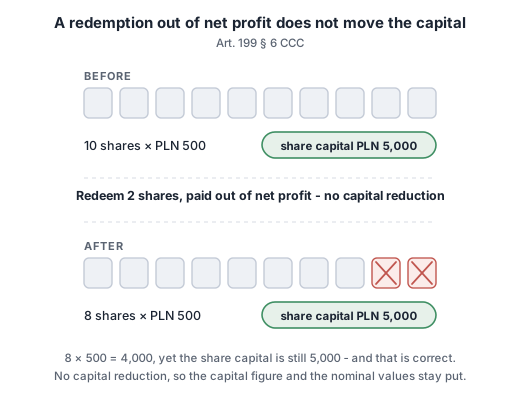
For precision: a redemption out of net profit produces a result that surprises people the first time they see it. The shares are gone, but the share capital figure does not move and neither do the nominal values of the surviving shares. A company with 10 shares of PLN 500 each has share capital of PLN 5,000; redeem 2 out of net profit and you are left with 8 shares of PLN 500 - share capital still PLN 5,000, even though eight times five hundred is four thousand. The arithmetic no longer ties, and that is correct: there has been no capital reduction. What does move is the capital the payment comes from - typically a reserve capital - which goes down by the amount paid, together with the cash. The articles do not have to be amended to match; if you want the figures to tie again you can raise the nominal value of the remaining shares, but there is no obligation to.
Out of a reduction of share capital
The other route funds the redemption by reducing the share capital (Art. 199 § 7 KSH, with Art. 263–265 KSH). This is the ordinary redemption, and it buys you something the net-profit route cannot: it can reach into the capital itself, not just the distributable surplus. The price is the creditor-notification procedure and its three-month window - the roughly four-month timeline covered in the companion article on capital reductions. And the redemption only takes effect when the reduction is registered, not when the resolution is passed.
Neither route is the “right” one. The net-profit redemption is fast but limited to distributable surplus; the capital-reduction redemption is slower but can return capital proper. And they are not mutually exclusive - there is nothing to stop you running two redemptions at once: a quick one out of net profit and, alongside it, an ordinary one that reduces the share capital. On a structure that needs both speed and a genuine capital return, that combination is often the neatest answer.
Buying out a co-shareholder - with the company’s money, not your own
One of the most useful things a voluntary redemption does is let one shareholder take over from another without reaching into their own pocket. Instead of the staying shareholder buying the leaver’s shares, the company redeems them: the leaver gives up their shares for a price the two sides agree - and because this is a voluntary redemption, that price is whatever they settle on, not a statutory figure - and the company pays it, out of its own account.
In practice this is a frequent transactional move. The staying shareholder does not fund the exit - the company does, out of its own cash. A company often sits on good liquidity or accumulated reserves, so the money is already there, and the remaining shareholder ends up holding the whole company without having tied up any of their own resources.
Funded out of net profit, the effect is immediate: the leaver’s shares are redeemed and they are out at once, with no capital reduction and no creditor-notification procedure to wait through. Fund the same buy-out from a capital reduction instead and the leaver only goes once the reduction is registered, after the three-month creditor window. On the net-profit route the price is capped by the distributable surplus; on the capital-reduction route it can also draw on the capital released. Either way the price is taxed on the leaver as a disposal of their shares - a point to settle with the tax adviser before the number is agreed.
Redemption without consideration: the quiet structuring tool
With the shareholder’s consent, a share can be redeemed for nothing (Art. 199 § 3 KSH). In a wholly-owned or closely-held group - where the “consent” is simply the group deciding to reorganise itself - this turns redemption into a tidying instrument rather than a cash-return one.
I used it for a client who wanted a holding company out of the structure. The operating company redeemed 100% of the holding company’s shares without consideration, and the holding company stopped being a shareholder. The driver was the so-called Estonian CIT (ryczałt od dochodów spółek) - a Polish regime under which a company is taxed only when it distributes its profit, not as the profit is earned - which a company may use only if every one of its shareholders is an individual. So the individuals came in as shareholders first, and then the holding tier was redeemed away.
That story carries the single most important trap with it: the operating company could not simply redeem the holding company’s shares and be left with no shareholder. A company cannot exist without one. The individuals had to be in place first. More on that in Watch out.
A redemption without consideration also has a balance-sheet use. In my practice I have used it to improve a company’s balance-sheet position - for example where an accumulated loss was getting in the way of financing, or where the company’s ratios were drifting towards a level that would have touched a covenant on an investment loan.
For precision: the effect comes from the capital-reduction variant. Nothing is paid out, so the share capital released by the reduction can absorb the accumulated loss: the loss disappears from the balance sheet and the structure of equity improves, but total equity stays where it was. That helps with tests that look at the loss position or at losses against capital; a covenant measured on total equity will not move. Being a capital reduction, it also runs through the creditor-notification procedure. Run the exact accounting with the company’s accountant.
What this means for you
Treat redemption as another way of getting the company’s own funds to its shareholders - one that works at moments when a dividend is not available, and that, in its capital-reduction form, reaches where a dividend cannot: into the share capital itself. A dividend is paid once a year, in proportion to every holding. A redemption can be done between annual meetings, and - when it is funded from a capital reduction - out of capital, not only out of distributable profit. So if you simply want to move the year’s profit to the shareholders, a dividend is the simpler tool; redemption earns its place when the timing or the source of the money is the point, or when a shareholder or a whole tier is to come out of the structure.
Between annual meetings, when a dividend is not available, redemption out of net profit is one of the quickest ways to move money to a shareholder - alongside an interim dividend, a repayment of additional contributions (dopłaty) where the company has any, and a capital reduction. Of those, the net-profit redemption is usually the fastest, because it skips the creditor procedure entirely.
And if the goal is structural - a shareholder out, a tier collapsed, a balance sheet tidied - redemption, and especially redemption without consideration, is often the cleanest route of all, provided the articles allow it and someone remains a shareholder at the end.
Watch out
- No clause, no redemption. If the articles do not provide for redemption, you must amend them first. For compulsory and automatic redemption the articles need the grounds and the procedure, not just a general permission.
- You cannot add a compulsory-redemption clause behind a shareholder’s back. Introducing compulsory or automatic redemption by a later amendment affects a shareholder who did not sign up to it. Polish commentators are divided on whether that needs their consent; the better view, and the one I act on, is that it diminishes their rights and so it does (Art. 246 § 3 KSH). In practice a two-thirds majority is not enough: you need the consent of every shareholder already in the company whom the clause would affect.
- The company must always keep a shareholder. You can never redeem every share. If a shareholder is to be fully redeemed out, someone else has to be holding shares at the end - line up the replacement before you cancel.
- Not during liquidation, not before registration. A company in liquidation cannot redeem (it would cut across the ban on distributing assets before creditors are paid), and nor can a company in organisation.
- The compulsory floor is real. A compulsory or automatic redemption has to pay at least the net-asset value attributable to the share from the last financial statements, less the amount earmarked for distribution. You cannot set the price below it, and the resolution must give reasons.
- Overpaying out of the company is an unlawful payment. Whatever the type, the price must fit the funding limit of the route you use - and that includes paying out agio, if a court takes the prevailing view. Anything above the limit has to be returned by the shareholder, and the board members responsible are jointly liable for it (Art. 198 KSH). This bites hardest in a buy-out funded by the company: on the capital-reduction route nothing may be paid before the reduction is registered, and with more than two shareholders, redeeming one of them at a negotiated price must respect the equal treatment of shareholders in like circumstances (Art. 20 KSH) - get the others’ agreement on the record.
- The tax treatment follows the type, and it is not uniform. A voluntary redemption (the company buys the share and cancels it) is taxed on the shareholder as a disposal of shares; a compulsory or automatic redemption is taxed as participation in the company’s profits, with the same 19% withholding machinery a dividend carries - and the same EU/EEA exemptions and treaty relief that can switch it off. A redemption for no consideration generally produces no income for the company. Whether the company’s acquisition of the share attracts transfer tax (PCC) is contested. These are signposts only - confirm each with your Polish tax adviser.
Next steps
- Check the articles: is redemption allowed at all, and if you need the compulsory or automatic route, are the grounds and procedure there? If not, plan the amendment first.
- Decide the type - voluntary, compulsory or automatic - by what the situation actually is: a consensual pay-out or exit, a pre-agreed trigger, or an automated one.
- Decide the funding route - net profit (fast, limited to distributable surplus) or capital reduction (slower, reaches capital). Consider running both if you need speed and a capital return.
- Confirm the numbers: how much distributable surplus the last financial statements support (for the net-profit route) and, for a compulsory or automatic redemption, the statutory floor.
- Run the tax treatment of the chosen type past your Polish tax adviser before you resolve anything.
- Make sure a shareholder will remain after the redemption - put any replacement in place first.